|
|
 |
Boxes
Have you ever
seen an auction for a kit you were interested in,
but couldn't tell if it was a 1971 or 1972 issue
from the picture? Well, you could email the
seller and ask. Then hope he knows the answer.
Or, you could take a look at some of the
information I have put here.
|
|
First
off, the '72 boxes are bigger than the 71
boxes. Only problem is, unless they are
side by side, it's really hard to tell
which is which from a picture that way.
If you can see one of the sides of the
box, then you can know for sure.
This one is an easy one.
No sides look the same as each other.
Forget about the front for a minute
though and look at the other sides. The
71 is on top, and the 72 is on the
bottom. Look at the left and right sides.
On the 72 there are pictures of all 14
kits on the side panels. On the 71 you
have the cool picture on the one side,
then the text panel on the other side. On
the back, 71's are identical to the
front. On the 72's you have the same
picture as the front, except the text
panel is on top of it.
|
| Ok, what if you can only
see a crappy picture of the front? No
problem it you know what to look for. |

|
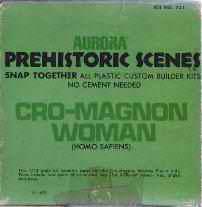
.Now take a good look at
the picture to the left. The 71 is on
top, 72 on the bottom. What do you see
that is different?
The Aurora name is in color on the 71, it
is in white on the 72.
The name Prehistoric Scenes is in white
on the 71 and in black on the 72.
The name of the model is almost in the
center of the box on the 71. It is more
towards the bottom on the 72. |
Lets move on to the top/bottoms now.
The top and bottoms are the same on the
boxes. Pictured to the right are the 71
on top, and the 72 on the bottom.
Besides the fact that the date is printed
on the top/bottom, there are a couple
other obvious differences.
71 has the kit name printed in color,
where the 72 has it in white.
71 has the words "snap
together" in bold, where the 72 has
the words "no cement needed" in
bold instead. |


|
| While we are talking
about tops, lets look at something else
while we are here. |

|
|

|
Take a close look at the
3 pictures above and see if you can pick
out the differences. You will have to
click on the pictures and look at the
larger versions.
Give up? Here's the answer. The one on
the left is a US box. The middle one is a
UK (Eurorpean) box. The right one is
Canadian.
How do I know? Look at them again. Look
along the bottom of the flaps. The US top
says "PRINTED IN CANADA MADE IN
USA". Hence a US box. The Canadian
one says "MADE IN CANADA PRINTED IN
CANADA. It also says "INSTRUCTIONS
EN FRANCIAS A L'INTERIEUR" which I
belive says instructions in French. Now
the middle one is tricky unless you know
what to look for. That's because it
doesn't say anything. No "MADE
IN" or "PRINTED IN". Which
means is wasn't made in the US or Canada.
That only leaves elsewhere. The only
elsewhere that Aurora made kits was
Europe.
|
Now to the really tricky
stuff. How to tell the different
nationalities from the front of the box.
All 3 of the boxes below are Canadian.
The one on the left is a 1971 Canadian.
See the little printing above the white
"prehistoric scenes". Says
instructions in French. The middle one is
a 1972 Canadian. See the small printing
above the black "prehistoric
scenes". Same as the left one. Now
for the twist. The one on the right is a
1972 Canadian. How can you tell? You
can't from this picture. The only reason
I know is because I have the box and it
says made in Canada on the top flap.
I don't know why there are some that have
the printing on the front and others
don't. Maybe after I handle a few more I
will find a patten. For now it is another
one of those mysteries. |
 |
 |
 |
| Now you're probably
wondering about the Eurorpean versions.
Well I don't know any way to tell from
the front. The only European I have looks
identical to the US version. If anyone
has any other information they would like
to share, I would be glad to hear it.
If you have anything that shows I am
wrong on any of this, please let me know.
|
|
|
|


